วันอาทิตย์ที่ 28 เมษายน พ.ศ. 2556

การฝึกอบรมครูฝึกว่าด้วยการป้องกันการก่อการร้ายที่ใช้อาวุธชีวภาพ


  การฝึกอบรมครูฝึกว่าด้วยการป้องกันการก่อการร้ายที่ใช้อาวุธชีวภาพ (INTERPOL Bioterrorism Train the Trainers session) ระหว่างวันที่ 18 – 22 กุมภาพันธ์ 2551 ณ ประเทศฟิลิปปินส์ โดยสำนักเลขาธิการองค์การตำรวจสากล
AGENDA FOR THE TRAIN THE TRAINERS SESSION IN PHILIPPINES

DAY 1 Prevention 09:00 – 09:15 Opening Session 
09:15 – 10:15 Course/Delegates introduction 
10:15 – 10:30 Terrorism and CBRN use 

10:30 -- 10:45 Discussions 
10:45 – 11:00 Coffee break 
11:00 –11:15 Deliberate Use of a Biological Agents and Toxins 
11:15 – 11:30 Discussions 
11:30 – 11:45 Bio Devices 
11:45 – 12:00 Discussions 
12:00 – 13:30 Lunch 
13:30 – 13:45 Risk/Threat Assessment 
13:45 – 14:00 Discussions 
14:00 – 14:15 Prevention – Public Health/LE 
14:15 -- 14:30 Discussions 
14:30 – 14:45 Prevention – Bio Security 
14:45 – 15:00 Discussions 
15:00 – 15:15 Preventing misuse of biological agents-BK 
15:15 – 15:30 Discussions 
15:30 – 16:00 Coffee Break 
16:00 – 17:30 Syndicate Group Work 
17:30 - 18:00 Day 1 final discussions 

DAY 2 Response
09:00 – 09:15 Review of the first day 
09:15 – 09:30 First Line of Defense 
09:30 – 09:45 Discussions 
09:45 – 10:00 Second Line of Defense 
10:00 – 10:15 Discussions 
10:15 – 10:30 Public Communication Issues 
10:30 – 10:45 Discussions 
10:45 – 11:00 Coffee Break 
11:00 – 11:15 Response – Law Enforcement 
11:15 – 11:30 Discussions 
11:30 – 11:45 Response – Public Health 
11:45 – 12:00 Discussions 
12:00 – 12:15 Legal basis for response 
12:15 – 12:30 Discussions 
12:30 – 13:00 Topic selection and group discussion with experts 
13:00 – 14:00 Lunch 
14:00 – 15:30 – Syndicate Group Work 
15:30 – 15:45 Coffee Break 
15:45 – 17:00 - Syndicate Group Work(cont) 
17:00 - 17:30 – Day 2 final discussions 

DAY 3 Legislation
09:00 – 09:15 Topic Introduction 
09:15 – 10.45 Legislation discussions 
10:45 – 11:00 Coffee Break 
11:00 – 13.00 Legislation discussions 
13:00 – 14:00 Lunch 
14:00 – 15:30 – Legislation discussions 
15:30 – 15:45 Coffee Break 
15:45 – 17:00 - Legislation discussions 
17:00 - 17:30 – Day 3 final discussions 

DAY 4: Exercise
09:00 – 12:00 Crime Scene Investigation 
  Bio agents Identification 
  Personal Protective Equipment 
  Crime Scene Examination 

Coffee Break Included 
12:00-13:00 – Lunch 
13:00 – 14:00 Travel to the Bio Lab 
14:15-17:00 Work Stations, Practical Learning 
17:00 – 18:00 Travel to the hotel 
DAY 5: Exercise 
08:15 - 09:30 Travel to the Bio Lab (TBC) 
09:30 – 12:00- Practical Exercise 
12:00-13:00 - Lunch 
13:00-16:00 Practical Exercise(cont) 
16:00-17:00 Final discussions and certificates handout 
17:00-18:00 Travel to the hotel 


วันศุกร์ที่ 1 มีนาคม พ.ศ. 2556

มาตรฐานสากลที่เกี่ยวข้องกับการตรวจวัดถังที่ใช้เป็นภาชนะรับผลิตภัณฑ์ปิโตรเลียมและของเหลวที่นำเข้ามาจากต่างประเทศ


    มาตรฐานสากลที่เกี่ยวข้องกับการตรวจวัดถังที่ใช้เป็นภาชนะรับผลิตภัณฑ์ปิโตรเลียมและของเหลวที่นำเข้ามาจากต่างประเทศนี้ ดร.สงบ สิทธิเดช ได้ทำการศึกษาและได้นำลงเผยแพร่ใน Sangobsite Google ตั้งแต่ June 20, 2011 ผู้เขียนเห็นว่าเป็นงานการศึกษาที่น่าสนใจจึงได้นำมาเผยแพร่ในบล็อกนี้

ถังในที่นี้หมายถึง ภาชนะรับผลิตภัณฑ์ปิโตรเลียมและของเหลวที่นำเข้ามาจากต่างประเทศในลักษณะ Bulk Cargo ได้แก่ ถังทรงกระบอกแนวตั้ง ถังทรงกระบอกแนวนอน และถังทรงลูกโลก เป็นต้น ทั้งนี้ตามประกาศกรมศุลกากร ที่ 128/2541 ข้อ 1 ได้กำหนดให้ ถังที่ผู้นำเข้าหรือเจ้าของถังมีความประสงค์จะใช้เป็นภาชนะรับผลิตภัณฑ์ปิโตรเลียมและของเหลวที่นำเข้าจากต่างประเทศในลักษณะ BULK CARGO จะต้องได้รับการตรวจสอบสภาพถังและรับรองตารางคำนวณปริมาตรความจุประจำถังจากกรมศุลกากร

มาตรฐานสากลที่เกี่ยวข้องกับการตรวจวัดถัง
ปัจจุบันมาตรฐานสากลที่เกี่ยวข้องกับการตรวจวัดถัง จากการศึกษาพบว่า ที่มีการอ้างถึงมากที่สุดได้แก่มาตรฐาน ISO, API, ASTM, EI (เทียบตามตารางแนบท้าย) สรุปได้ดังนี้
(1) API (American Petroleum Institute)[i] กำหนดคู่มือมาตรฐานการวัดปิโตรเลียม (MPMS: Manual of Petroleum Measurement Standards) และมาตรฐานวิธีการตรวจวัดและคำนวณ (STD:  Standard) ด้วยวิธีการต่างๆ ดังนี้
   (1.1) API MPMS 2.2A / API STD 2550: Measurement and Calibration of Upright Cylindrical Tanks by Manual Strapping Method เทียบเท่า ASTM D1220, EI HM2 และ ISO 7507-1
   (1.2) API MPMS 2.2B: Calibration of Upright Cylindrical Tanks using the Optical Reference Line Method เทียบเท่า ISO 7507-2
   (1.3) API MPMS 2.2C: Tank Calibration by Optical Triangulation Method เทียบเท่า ISO 7507-3
   (1.4) API MPMS 2.2D: Tank Calibration by Internal Electro-Optical Distance-Ranging Method เทียบเท่า ISO 7507-4 สำหรับวิธีการวัดโดยใช้กล้อง EODR นี้ ถือว่าเทคโนโลยีใหม่ที่พัฒนามาจากวิธีการที่ 1.3 และกำลังเป็นที่นิยมใช้งานกันอยู่ในขณะนี้ (อ้างจากบทความ New tank calibration method could be wave of the future[ii])
   (1.5) API MPMS 2.2E / API STD 2551: Petroleum and Liquid Petroleum Products - Calibration of Horizontal Cylindrical Tanks - Part 1: Manual Methods เทียบเท่า ASTM D1410 และ ISO 12917-1
   (1.6) API MPMS 2.2F: Petroleum and Liquid Petroleum Products - Calibration of Horizontal Cylindrical Tanks - Part 1: Manual Methods เทียบเท่า ISO 12917-2
   (1.7) API MPMS 2.2G / API STD 2555: Liquid Calibration of Tanks เทียบเท่า ASTM D1406 และ ISO 4269
   (1.8) API STD 2552 Measurement and Calibration of Spheres and Spheroids เทียบเท่า ASTM D1408
หมายเหตุ: ในบทความ Guidelines help select storage tank calibration method[iii]     ได้สรุปวิธีการวัดหลักๆ เป็น 4 วิธี คือ Manual strapping, Optical reference line, Optical triangulation และ Electro optical distance ranging ตามข้อแนะนำให้เลือกใช้วิธีใดวิธีหนึ่งหรือหลายวิธีร่วมกันขึ้นอยู่กับปัจจัยต่างๆ ของถังที่ทำการตรวจวัด ได้แก่ (1) Type of tank: floating or fixed roof (2) Operational constraints: entry or no entry (3) Insulation or no insulation (4) Riveted or welded (5) Other parameters such as number/size of wind girders
(2) ISO (International Organization for Standardization)[iv] อ้างถึง TC 28 - Petroleum products and lubricants ได้แก่ ISO 7507 1 – 4, ISO 12917-1, ISO 12917-1 และ ISO 4269
(3) ASTM (American Society for Testing and Materials) / ANSI (American National Standards Institute)[v] อ้างถึง D1410, D1406, D1408
(4) EI (The Energy Institute)[vi] อ้างถึง Hydrocarbon management ได้แก่ HM 2: Tank calibration. Section 1: Strapping, internal diameter and internal offset methods for the calibration of vertical cylindrical tanks (formerly PMM Part II, S1)

API - EI - ISO-ASTM Corresponding Standards List
API MPMS
API Title
API STD
EI
ISO
ASTM
2.2A
Measurement and Calibration of Upright Cylindrical Tanks by Manual Strapping Method
2550
HM 2
7507-1
 D1220
2.2B
Calibration of Upright Cylindrical Tanks using the Optical Reference Line Method


7507-2

2.2C
Tank Calibration by Optical Triangulation Method


7507-3

2.2D
Tank Calibration by Internal Electro-Optical Distance-Ranging Method


7507-4

ISO 7507-5: Petroleum and liquid petroleum products - Calibration of vertical cylindrical tanks - Part 5: External electro optical
7507-5
2.2E
Petroleum and Liquid Petroleum Products - Calibration of Horizontal Cylindrical Tanks - Part 1: Manual Methods 
2551

12917-1
D1410
2.2F
Petroleum and Liquid Petroleum Products - Calibration of Horizontal Cylindrical Tanks - Part 2: Internal Electro-Optical Distance-Ranging Method


12917-2

2.2G
Liquid Calibration of Tanks
 2555

 4269
 D1406

Measurement and Calibration of Spheres and Spheroids
2552


D1408


[i] http://www.api.org/,
http://en.wikipedia.org/wiki/American_Petroleum_Institute,
http://www.docstoc.com/docs/20276637/Manual-of-Petroleum-Measurement,
http://www.petrospection.com.au/WYNTK%20Tank%20Cal.htm
[ii] http://www.ogj.com/index/article-display/16352/articles/oil-gas-journal/volume-90/issue-42/in-this-issue/refining/new-tank-calibration-method-could-be-wave-of-the-future.html
[iii] http://www.ogj.com/index/article-display/18379/articles/oil-gas-journal/volume-88/issue-6/in-this-issue/refining/guidelines-help-select-storage-tank-calibration-method.html (online: 03.11.10)
[iv] http://www.iso.org/iso/home.html,
http://www.iso.org/iso/iso_catalogue/catalogue_ics.html,
http://www.iso.org/iso/iso_catalogue/catalogue_tc.html
[v] http://www.astm.org/index.shtml,
http://global.ihs.com/news/temp/standards/ASTM-17.html
[vi] http://www.energyinst.org/home,

วันจันทร์ที่ 18 กุมภาพันธ์ พ.ศ. 2556

Multilateral Export Control Regimes (ECR)


Multilateral Export Control Regimes (ECR) หมายถึง กลุ่มประเทศในภูมิภาคต่างๆ ที่ออกกฎระเบียบควบคุมสินค้าที่อาจใช้ประโยชน์ได้สองทาง (ตามแผนภูมิภาพข้างล่าง) ในบทความต่อไปนี้จะเป็นการศึกษาลงลึกในแต่ละกลุ่มประเทศว่ามีประเทศอะไรบ้าง มีกลุ่มสินค้าอะไรที่อยู่ข่ายควบคุมการนำเข้าและส่งออกในประเทศนั้น ๆ ซึ่งจะเป็นประโยชน์อย่างมากกับผู้ประกอบการค้าไทยที่จำเป็นจะต้องรู้กฎระเบียบข้อห้ามข้อจำกัดก่อน ที่ท่านจะส่งสินค้าเข้าไปขายยังประเทศ นั้นๆ


Dr.Sangob Sittidech
Copyright, Update May 4, 2013

วันจันทร์ที่ 16 กรกฎาคม พ.ศ. 2555

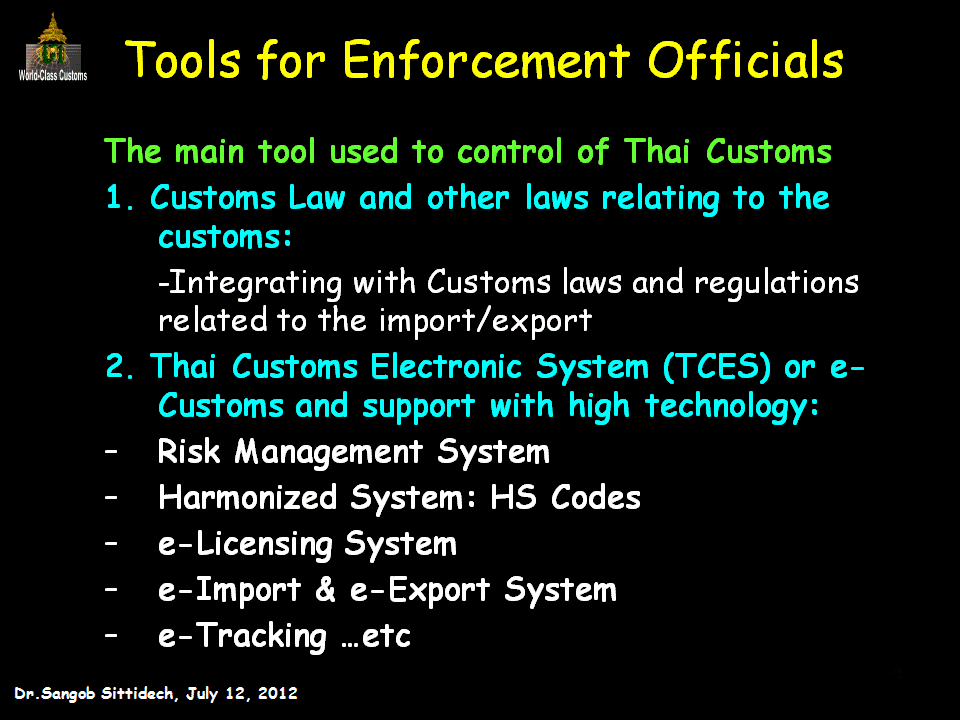
Strategic Goods Awareness and Tools for Enforcement Officials


Asia-Pacific Strategic Trade Experts Network (STEN)
July 11-12, 2012
Sarocha meeting Room, Siam Kempinski Hotel, Bangkok

            Strategic Goods Awareness and Tools for Enforcement Officials Effective enforcement of STCs requires that enforcement officials are aware of what strategic goods are subject to control. Armed with this knowledge, they also need tools and resources to support enforcement actions on shipments that may contain controlled items. This session will provide participants an opportunity to share experiences in supporting the enforcement function of STCs.

0900–1045            Regional Experience Sharing 
Strategic Goods Awareness and Tools for
 Enforcement Officials: Thai Experience Sharing
by Dr. Sangob Sittidech, Royal Thai Customs


 Copy Right by Dr.Sangob Sittidech
July 16, 2012


วันอังคารที่ 21 กุมภาพันธ์ พ.ศ. 2555

Customs Law Concerning the Strategic Trade Control by WMD CIT working group

By WMD CIT working group
February 20, 2012
At the Customs Department

Dr.Sangob Sittidech
Customs Technical  Officer, Professional
WMD CIT working group

Customs Law Concerning the Strategic Trade Control by WMD CIT working group

1. The Strategic Trade Control

Customs is now playing the major role to balancing facilitation and control the movement of goods

Vision Statement
World-class Customs for competitiveness and social protection
Mission
1. To provide modern, expeditious, and global standard Customs service
2. To promote economic development and national competitiveness by implementing Customs-related measures
3. To enhance efficiency in Customs control, targeting at social protection
4. To collect revenue in an efficient, fair and transparent manner
Strategies
1. To develop Customs measures, targeting at national competitiveness
2. To develop capacity for Customs control, focusing on the international standards
3. To manage a revenue collection system, focusing on the good governance principle

2. on WMD CIT Working Group
1. WMD CIT working group is in short of … Weapon of Mass Destruction Commodity Identification Training
2. Established by the Department of Customs on April 18, 2011 with the cooperation of the Export Control and Related Border Security, the U.S. Embassy in Thailand
3. The purpose of WMD CIT working group
          3.1 To train customs officers to involve in the control of import - export and to gain  knowledge of materials and equipment related to WMD as specified in the control lists: NSG, AG, MTCR, WA
3.2 To acknowledge the international rules of conduct related to WMD - that is two-ways
          3.3 To acknowledge the various laws, related to the WMD
          3.4 To recognize the threat of terrorism with weapons of mass destruction
          3.5 To inform the preparation of accounting and control system for Thai exports
          3.6 To prepare the export control system that works two ways


3. This systematic approach to control WMD

3.1 Input 4 Ms LT
All elements in the preparation of WMD (chemical weapons, biological, nuclear and missile)
1.  Man / Human: Personnel intermediary brokerage network in the illegal procurement 
2.  Money / Capital: Sources of investment funds 
3. Material: Raw materials, components, machinery and equipment manufacturing 
4. Technological: Software technology and green films
5. Logistics & Supply Chain: Transportation System  import, export, transfer / Tran-shipment, transit (The 3-5 is a Dual-use Goods)
6. Managerial: Management 

3.3 Output
1.       Chemical Weapons (Chemical)
2.       Biological Weapons (Biological)
3.       Nuclear Weapons (Nuclear)
4.       Missile (Missile)
–                  Ballistic missiles with ranges exceeding 300 km and more than 500 kg payload

3.4 Feed Back – Integrated Control
1. International regulations related to WMD - in the framework of multilateral / UN
                   1.1 In a multilateral framework:
                   NSG, AG, MTCR, WA, EC
                   1.2 The United Nations:
                   NPT, CTBT, CWC, BWC, UNSCR 1540,
                   UNSCR 1718
2. Domestic law relating to the control of import / export WMD: 11 volumes       
3. Trade measures and the monitoring of IAEA

4. Domestic law relating to the control of import / export WMD
Law and Regulations - Security Council resolution 1540 (2004): WMD
• The Customs Act (1926)
• The Act Controlling the Exportation of Arms, Armament and War
Implements (1952)
• The Atomic Energy for Peace Act (1961)
• The Export and Import Goods Act (1979)
(Cabinet resolution of July 20, 2010 - delegated to the Ministry of Commerce is the main agency in the preparation of management import - export of goods that are available dual‐use product.)
• The Disease Control Act (1980)
• The Munitions of War Control Act (1987)
• The Royal Decree Controlling the Exportation of Arms, Armament
and War Implements (1992)
• The Hazardous Substance Act (1992)
• The Amendment to the Anti-Money Laundering Act (1999)
• The Animal Disease Control Act (2001)
• The Pathogens and Toxins Act (2001)
• The Amendment to the Section of 135 of the Penal Code

5. Integrating with Customs laws and regulations related to the import / export of WMD


Copyright by
Dr.Sangob Sittidech
February 21, 2012

วันจันทร์ที่ 20 กุมภาพันธ์ พ.ศ. 2555

Thailand –Japan Export Control Seminar: Customs Control and Formalities

March 8, 2011 Crown Plaza Hotel
Lumpini Park Bangkok

Dr. Sangob  Sittidech
(LL.B., M.A., D.P.A.)
Customs Technical Officer, Professional
Bangkok Port Customs Bureau

Presentation out line
PART I Export Control System
PART II e-Export System
PART III Customs Role in - Protecting Cargo

PART I Export Control System
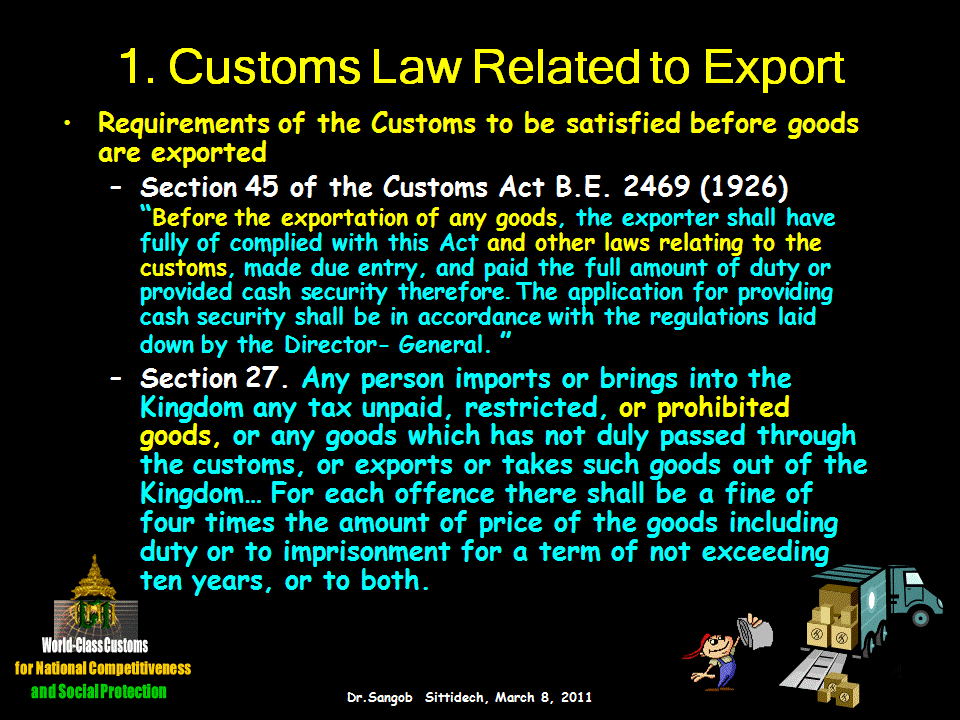
1. Customs Law Related to Export
•                   Requirements of the Customs to be satisfied before goods are exported
–                 Section 45 of the Customs Act B.E. 2469 (1926) “Before the exportation of any goods, the exporter shall have fully of complied with this Act and other laws relating to the customs, made due entry, and paid the full amount of duty or provided cash security therefore. The application for providing cash security shall be in accordance with the regulations laid down by the Director- General. ”
–                 Section 27. Any person imports or brings into the Kingdom any tax unpaid, restricted, or prohibited goods, or any goods which has not duly passed through the customs, or exports or takes such goods out of the Kingdom… For each offence there shall be a fine of four times the amount of price of the goods including duty or to imprisonment for a term of not exceeding ten years, or to both.

Customs Law Related to Other Laws
Law and Regulations - Security Council resolution 1540 (2004) : WMD
• The Act Controlling the Exportation of Arms, Armament and War
Implements (1952)
• The Atomic Energy for Peace Act (1961)
• Ministerial Regulations, issued under the order of the National
Administrative Reform Committee No. 37 (1976)
• The Export and Import Goods Act (1979)
(Cabinet resolution of July 20, 2010 - delegated to the Ministry of Commerce is the main agency in the preparation of management import - export of goods that are available dual‐use product.)
• The Disease Control Act (1980)
• The Munitions of War Control Act (1987)
• The Royal Decree Controlling the Exportation of Arms, Armament and War Implements (1992)
• The Hazardous Substance Act (1992)
• The Amendment to the Anti-Money Laundering Act (1999)
• The Animal Disease Control Act (2001)
• The Pathogens and Toxins Act (2001)
• The Amendment to the Section of 135 of the Penal

2. Licensing System by 15 digits
•                   Exporters must…..
–                 Obtain export license à 15 digits
    Licensing System for Tracking…Ex.
•                   สธ 0810 02 3 0227 38 àMinistry of Public Health
•                   กษ 0912 01 3 0030 38 àMinistry of Agriculture…
•                   กห 0206 02 0 0115 41 àMinistry of Defence
•                   อก 0412 02 3 0375 39 àMinistry of Industry
(Customs Notification 26/2544 Declaration in the list of entry permits for chemicals and hazardous materials)
.
–                 Submit Customs Entry document(s) within 15 days after Sub gate keyed Goods Transition Control (e-Export) into the system

3. Statistical code by HS

4. Risk Management System

Risk Management Profiles
There are 2 levels which are Central Profile & Local Profile.
Profiles (Central & Local)
•                   Business Profiles: Producers/Traders
•     Intelligence Data
•     International Agreement
•                   Complied with Standards of the Revised Kyoto Convention
•     Tariff code, Original of the goods, Shipment routing
•     List of Prohibited / Restricted Goods
•     Related Facts
Selection Criteria
•     High Risk: Inspect
•     Low Risk: Not inspect (Exempt)

PART II e-Export System
e-Export: Last Port
Documents
The minimum documents required to be submitted with the Export Declaration data consists of:
(1) Export Declaration data
(2) Invoice
(3) Export License (if applicable)
(4) Certificates of Origin (if applicable)
(5) Other relevant documents such as catalogue, product ingredients, etc.

e – Export Process 1

e – Export Process 2

PART III Customs Role in - Protecting Cargo
Protect cargo to high-risk container by used regulation
Thai & US Customs
Since the aftermath of the terrorist attacks USA in September 11, 2001. There are many programs took place to help the security of the United State such as
1. Container Security Initiative (CSI) 2003
2. Customs – Trade Partnership Against Terrorism (C-TPAT) 2001
3. 24-Hour Rule 2003
4. Mega Port Initiative (Radiation Detection)

Thai Customs & WCO
•                   WCO, Framework of Standards to Secure and Facilitate Global Trade : SAFE
•                   EU 2009, Authorized Economic Operator (AEO): EC Customs Security legislation Reg. 648/2005 and Reg. 1875/2006
•                   Authorized Economic Operator: an internationally recognized certification that an EU trader's role in the international supply chain is secure and customs controls and procedures are compliant.
•                   Department of Customs issued Customs Notification 84/2552 pilot program in which to obtain status as economic operators to be licensed. (Authorized Economic Operator: AEOs)

Caution on Exporters
Before exporting should consider the following issues;
1.       Checked before whether the goods are in the lists of export controls or other laws.
2.       If yes, should follow these procedures
1)      Request for permission to the relevant authorities before export.
2)      While exports (Ports Sub Gate) must verify that the product is waiting installation conditions make the risk to green or red.
3)      After sending out must submit the allowed documents to customs control of the port or airport at the final delivery to the Kingdom within 15 days from the date of matching - the goods  transition control.
         If filed thereafter, Customs officers will be considered guilty of the reason for not filing in a document in a reasonable time. [Customs Notification 116/2549 Article 53 (1)]


Copyright by
Dr. Sangob Sittidech
February 21, 2012 


สารบัญรวมบทความทั้งหมด

ที่ดินบ้านสวน 1 งาน ท่ามกลางธรรมชาติในโครงการโกลเด้นโฮมเชียงแสนฯ ผ่อนสบาย ๆ เดือนละหมื่นกว่าบาท 24 เดือน ได้เป็นเจ้าของทันที   สนใจติ...